West Chicago Immigrant Stories: They Came From Ireland
West Chicago celebrates our rich history of immigration, highlighting our four historic immigrant groups, Germans, English, Irish and Mexicans. On this St. Patrick’s Day we share some information about our early Irish immigrants.
In the 1850, 1860 and 1870 censuses, the largest number of foreign-born residents living here are from Ireland.
For hundreds of years, Ireland had an agriculture-based economy. The potato was introduced as a crop in the 1600s, and grew so well that it became a major food source. The danger of this dependence was seen in the 1840s when a fungus wiped out the potato harvest for four years and all available potatoes were exported to England. The result was the “Great Famine” or “Great Hunger,” in which one million Irish died due to starvation and disease. More than one million left the island and emigrated, mainly to the United States and Canada.
Although the Famine acted as a “push” factor in immigration, many Irish came to the United States due to the “pull” of economic opportunities awaiting them here. The 1850 census shows a significant amount of residents who arrived prior to the Famine period.
Many Irish came to Illinois by 1836 when work began on the Illinois & Michigan Canal. Irish laborers were recruited to dig the canal by hand and with scoops and shovels. Those who were skilled stonemasons shaped the limestone walls of the canal as well as buildings for homes and businesses along its route. By the time the canal was completed in 1848, the Galena & Chicago Union Railroad was building its roadbed west from Chicago. The railroad needed many workers, and Irish immigrants were eager to fill these jobs.
In many larger urban areas the Irish were not warmly welcomed. So many had come in poverty that Americans felt the Irish had a national tendency for irresponsible behavior that had made them poor. They were stereotyped as drunks and fighters, and discriminated against because of their Catholic faith. Fears that the Irish with their large families would overpopulate were voiced.
In this community, discrimination was not obvious. Perhaps it was due to the fact that the Irish were some of our earliest community members, and no one ethnic group had an advantage. Local Irish immigrants displayed a strong work ethic.
West Chicago’s Irish were integral community members in the early days of our town, including the Murphy family highlighted here.
Richard Murphy served in the United States Navy during the Civil War, although he had no prior experience as a sailor, and was a very recent immigrant to the country.
In November of 1862 he was living on Yellow Road in Waterford, Ireland, working as a plasterer, and on the 22nd of that month was married to Bridget Mullally in the Catholic Holy Church of the Trinity Without by Father Flynn Martin. The couple emigrated shortly thereafter, with plans to join Bridget's relatives in DuPage County, but less than a year after his marriage, on October 26, 1863, we find him enlisting in the U.S. Navy for a period of one year in Philadelphia on the receiving ship USS Princeton. There are 39 names on this enlistment page: 4 are from Waterford, with a total of 12 being from Ireland, one from Nova Scotia, one from Wales, and 25 from various other States. They range in age from 12 to 41. Union ship crews were generally like miniature world populations, with varying ethnicities while those of the South tended to be much more homogenous.
Murphy was received at the lowest rank, a landman, and is recorded as being a laborer, 26 years old, having blue eyes, black hair, freckled complexion, and being 5′5′′ tall. He would have been assigned a number for his hammock, another for his clothes bag, and assigned to a mess as well as given a naval uniform.
Murphy served on blockade ships tasked with keeping any Southern ships from getting out of their ports and preventing any others from getting into port. He served the longest aboard the USS Monticello. He was mustered out in Norfolk, Virginia on October 25, 1864, with the rank of coal heaver. Life on naval ships was a hard life as the men were exposed to unhealthy living conditions that took a toll on their bodies. They routinely endured incredible temperatures as they baked in the heat on deck or sweltered below deck. There were no earplugs for the cannon noises, and the men were continually drilled and instructed. The coal that fired the ships left black dust everywhere. It is no doubt that his time on the ships contributed to his rheumatism and failing eyesight he suffered later in life was at least partly caused by the time he served.
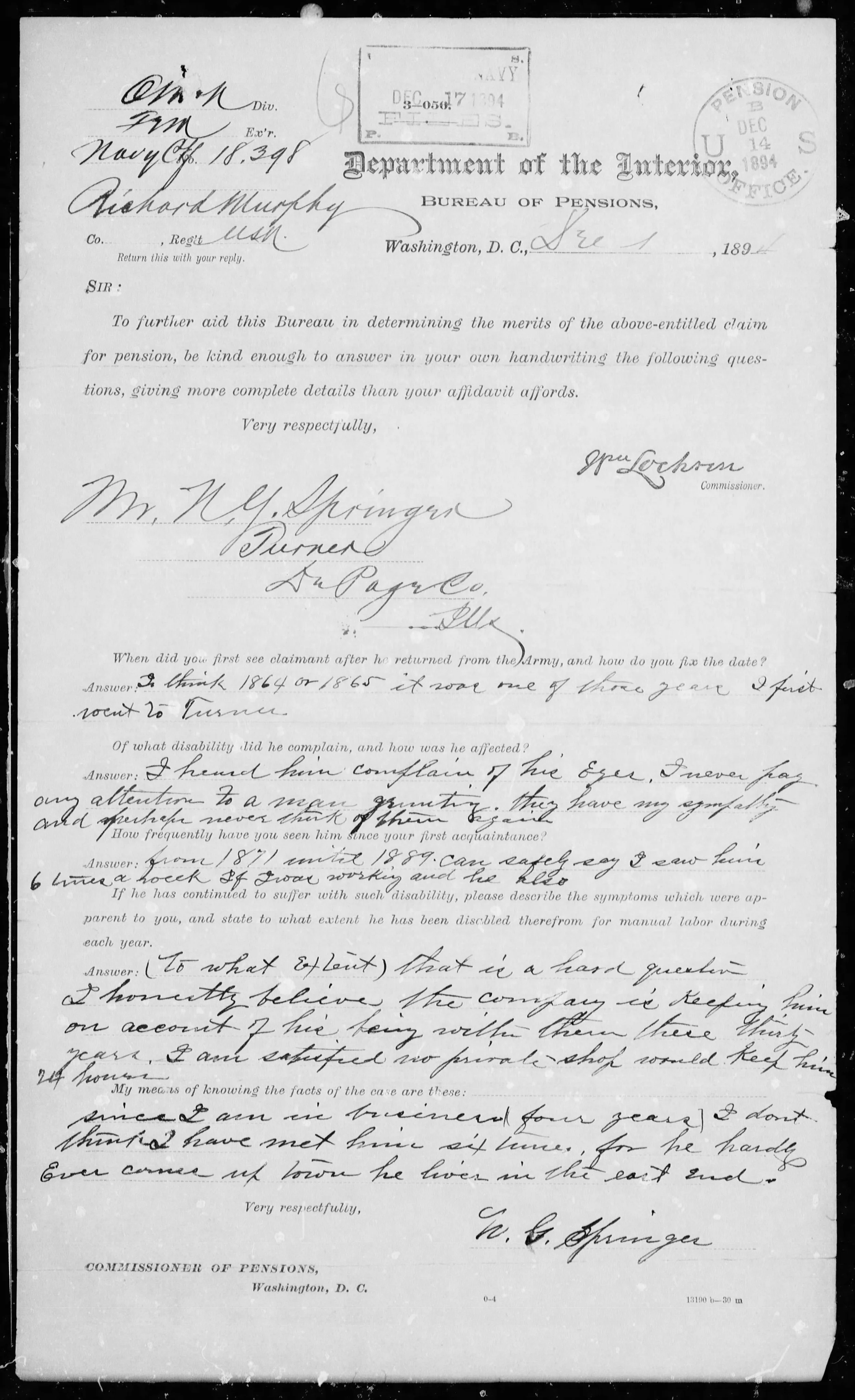
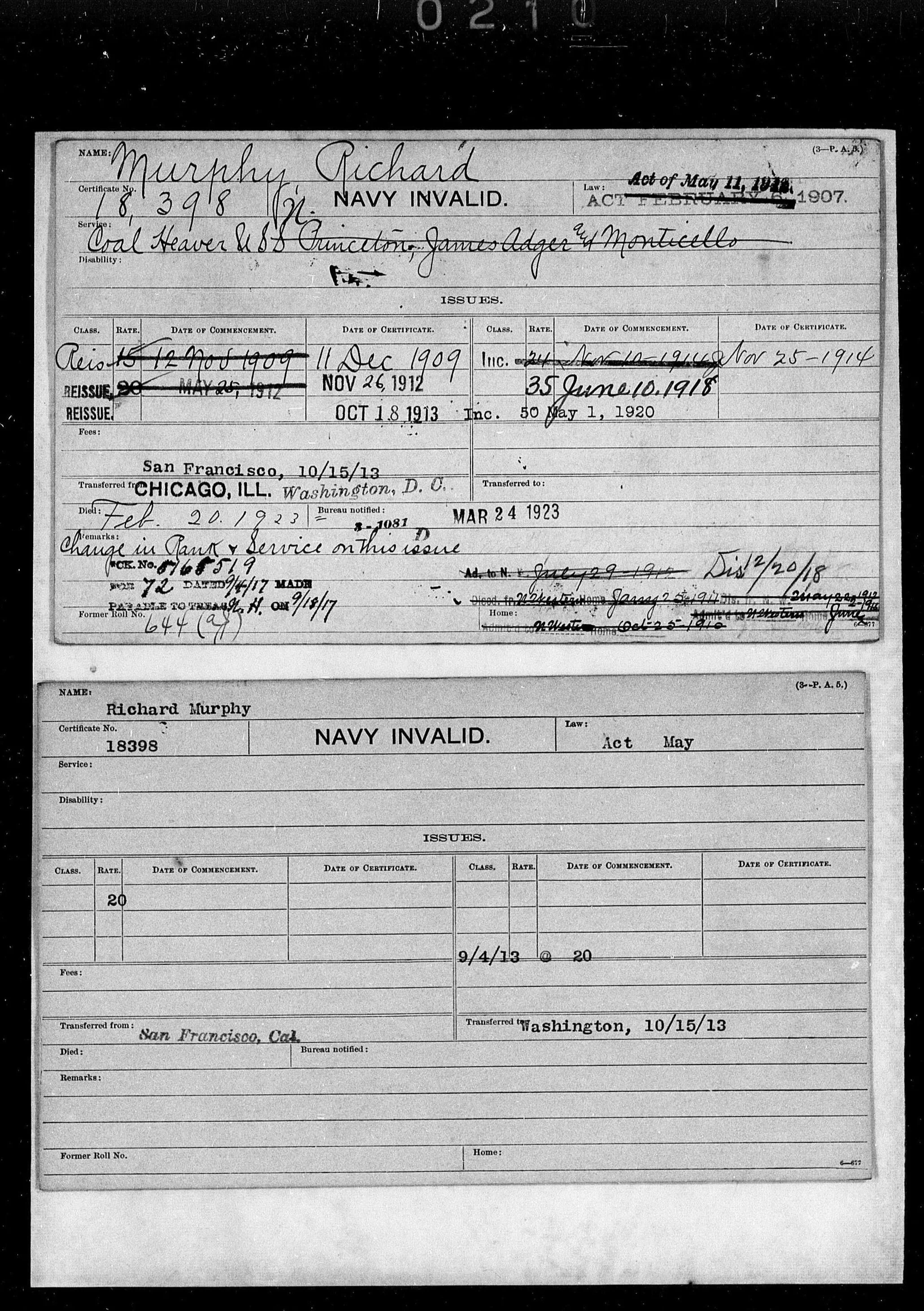
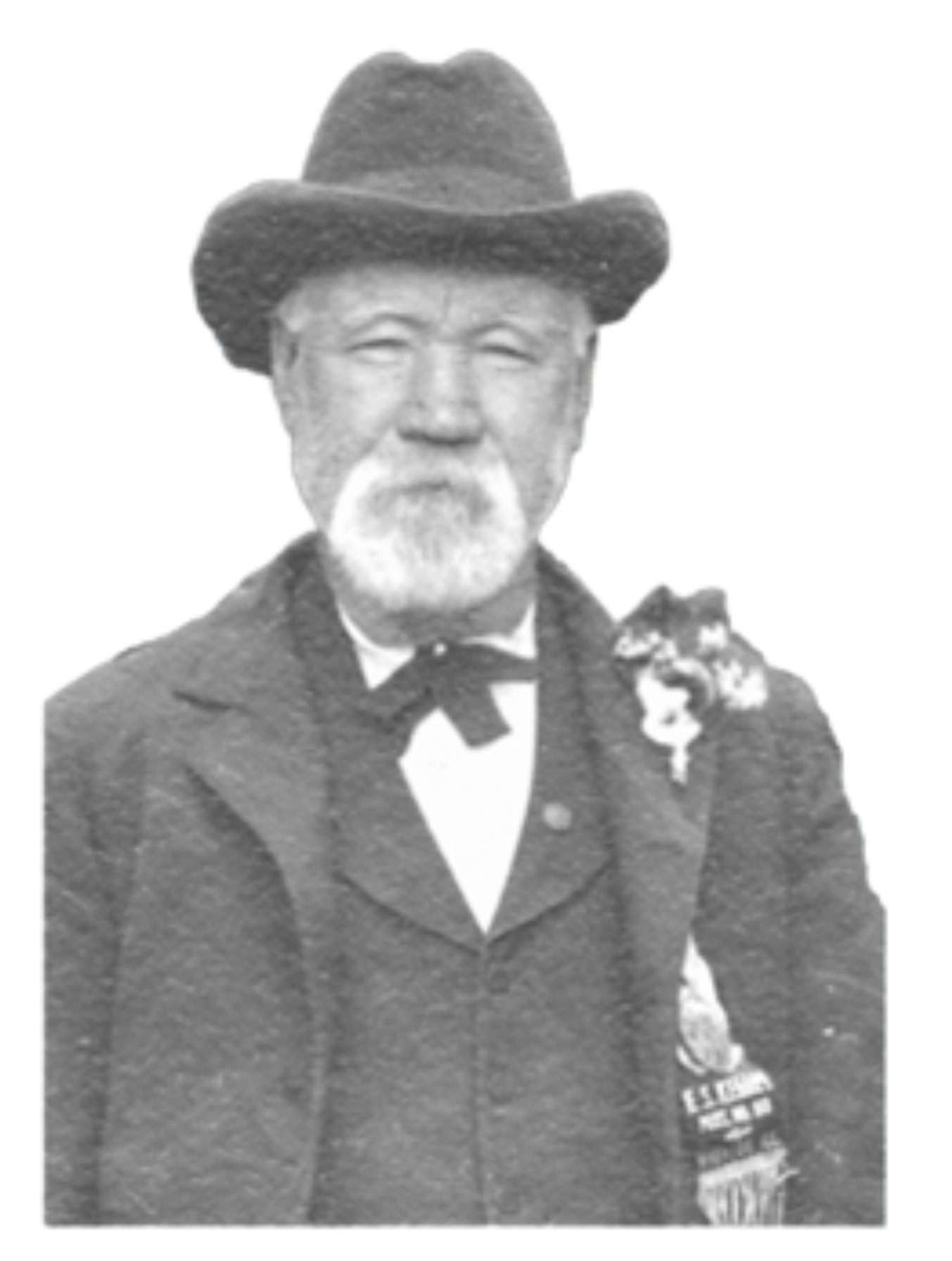
After his service, he and Bridget moved to the Turner (West Chicago) area, where he worked as a blacksmith in the Chicago & NorthWestern Roundhouse. After his ailments left him unable to work, he was able to receive a military pension. He was affectionately called "Old Dickie Bird" by his grandchildren who loved his story-telling. He spent many weeks in and out of the National Disabled Home for Soldiers and Sailors both in Quincy, Illinois, and Milwaukee, Wisconsin, when he was not staying with his daughter in Aurora. He died on February 20, 1923.